Restaurant Table Top Materials Compared: Sintered Stone, Marble, Quartz, Laminate, Wood
Sintered stone vs marble vs quartz vs laminate vs solid wood restaurant table tops: heat, stains, chipping, weight and repair compared in one table, with a buying checklist.
Short answer
For a busy restaurant, sintered stone is the most forgiving premium table top: it resists heat, practically doesn't absorb stains and holds its colour, but its edges must be protected against chips. Natural marble looks unmatched but etches under acidic food and drink and needs sealing; engineered quartz is stain-resistant but dislikes heat; laminate is light and economical but can't be repaired once the edge or core is damaged; solid wood is warm and refinishable but needs a commercial-grade finish.
No material wins on every axis. The right answer depends on what lands on the table (hot cast-iron pans? red wine? lemon?), how it is cleaned, how often tables are moved, and how long you expect the room to run before a refit.
What actually damages restaurant table tops?
Five things, in roughly this order of frequency:
- Chemical attack — acids (wine, citrus, vinegar, tomato, carbonated drinks) and cleaning chemicals, wiped on dozens of times a day.
- Staining — oil, coffee, red wine, turmeric, beetroot soaking into porous surfaces.
- Heat — hot plates, sizzling platters and cast-iron pans straight from the kitchen.
- Impact — chair backs, trays, bottles and table-to-table knocks, mainly at the edges.
- Abrasion — plates and cutlery sliding across the surface, and gritty cloths.
A good specification addresses each of these deliberately, rather than picking a surface from a sample board.
Table top materials compared
| Property | Sintered stone | Natural marble | Engineered quartz | High-pressure laminate (HPL) | Solid wood (lacquered) |
|---|---|---|---|---|---|
| Heat (hot plates) | Excellent | Good, may mark | Poor above roughly 300 °F (150 °C) — use trivets | Fair | Fair — use trivets |
| Staining | Excellent (very low porosity) | Poor unless sealed | Very good | Very good on face | Good with sound finish |
| Acid etching | Excellent | Poor — calcite etches | Very good | Good | Good |
| Scratch resistance | Excellent | Fair | Very good | Good | Fair |
| Edge chipping | Weak point — band or bevel edges | Moderate | Moderate | Edge band can lift | Dents rather than chips |
| Repairable | Limited | Can be honed and re-polished | Limited | Not really | Yes — sand and refinish |
| Approx. weight | ~6 lb/sq ft at 12 mm (~30 kg/m²) | ~11 lb/sq ft at 20 mm (~54 kg/m²) | ~10 lb/sq ft at 20 mm (~48 kg/m²) | ~4–5 lb/sq ft on 1–1¼ in core | ~5–6 lb/sq ft for 1½ in oak |
| Look | Marble, travertine, soapstone, concrete, solid colours | Unique natural veining | Uniform, some veined patterns | Any print, solid colours | Warm, natural grain |
Weights are approximate and vary with thickness and density; we state the actual weight of each top on our shop drawings.
Sintered stone: the default for heavy service
Sintered stone is made by compacting natural minerals under very high pressure and firing them at very high temperature, producing a dense slab with very low water absorption. In practice that means wine and oil sit on the surface instead of soaking in, acids don't etch it, and hot plates don't scorch it.
Its one weakness is impact at the edge. A thin slab with a sharp square edge will chip when a chair back or bottle hits it. The fix is in the detailing, not the material:
- Wood banding — the stone sits inside a solid timber frame that takes the knocks, as on our Stone-Top Tables.
- Mitred thick edge — two pieces of slab joined at 45° create a 2 in (5 cm) edge that looks like solid stone and spreads impact, as on the Calder Column System.
- Eased or bevelled edge — never specify a razor-sharp arris on a restaurant top.
Sintered stone is also relatively light for its look: a 12 mm slab weighs about half as much as 20 mm natural marble, which means smaller bases, easier handling and lower freight.
Natural marble and travertine: beautiful, but plan for patina
Marble and travertine are mostly calcium carbonate, which reacts with acids. Lemon juice, wine, vinegar and many cleaning products leave dull "etch" marks that no amount of wiping removes; only re-honing does. Sealers slow staining, but they don't stop etching.
That doesn't rule marble out. Plenty of brasseries run marble tops for decades and wear the patina proudly. If you choose real stone:
- Prefer honed over polished; etch marks show far less.
- Seal before installation and on a schedule (often every 6–12 months for busy tables — follow your fabricator's advice).
- Use pH-neutral cleaners only; avoid vinegar- or citrus-based products.
- Accept that the tables will look lived-in.
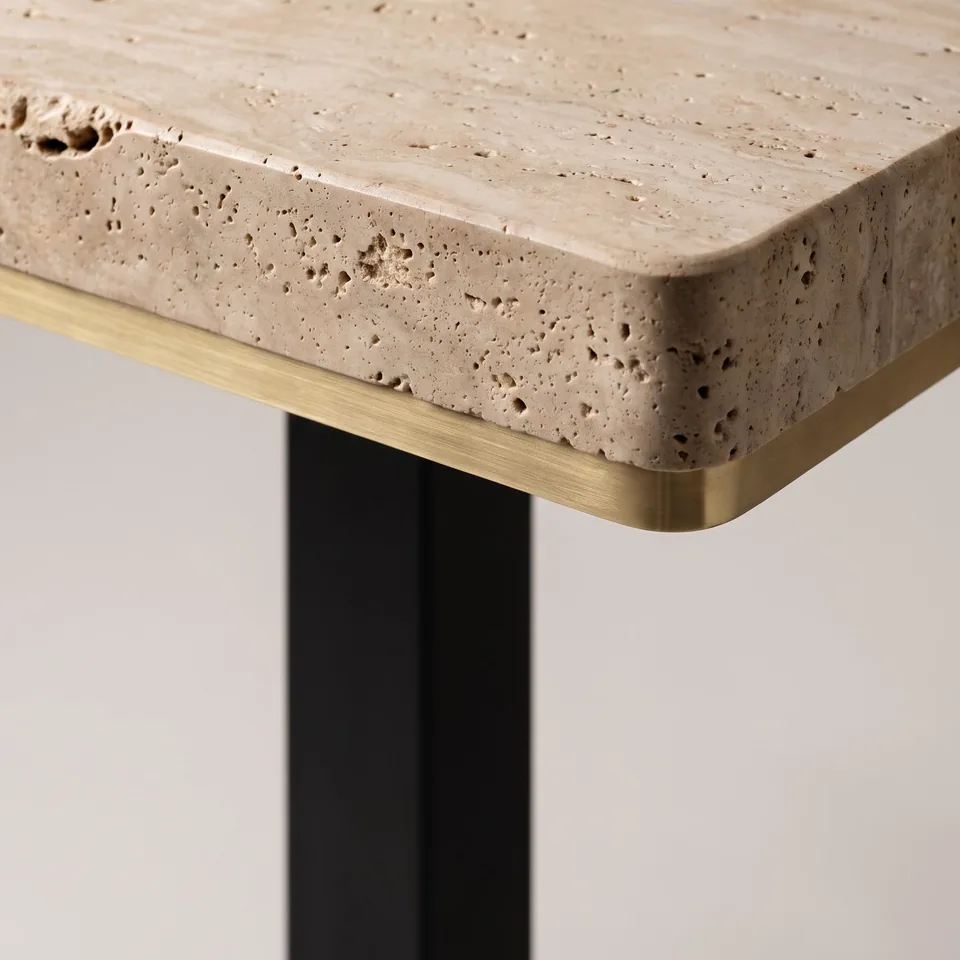
Travertine has natural holes, normally filled with resin at the factory; the fill can wear and reopen in heavy use. A travertine-look sintered stone gives the same visual with none of that maintenance.
Engineered quartz: stain-proof, heat-shy
Quartz surfaces are crushed quartz bound with polymer resin. They are dense and stain-resistant, but the resin can discolour or crack under concentrated heat — a hot skillet or sizzling platter can leave a permanent mark. Quartz is a good choice for cafés and bakeries; it is a riskier one for steakhouses, Korean barbecue or anywhere hot iron lands on the table.
Laminate: the economical workhorse
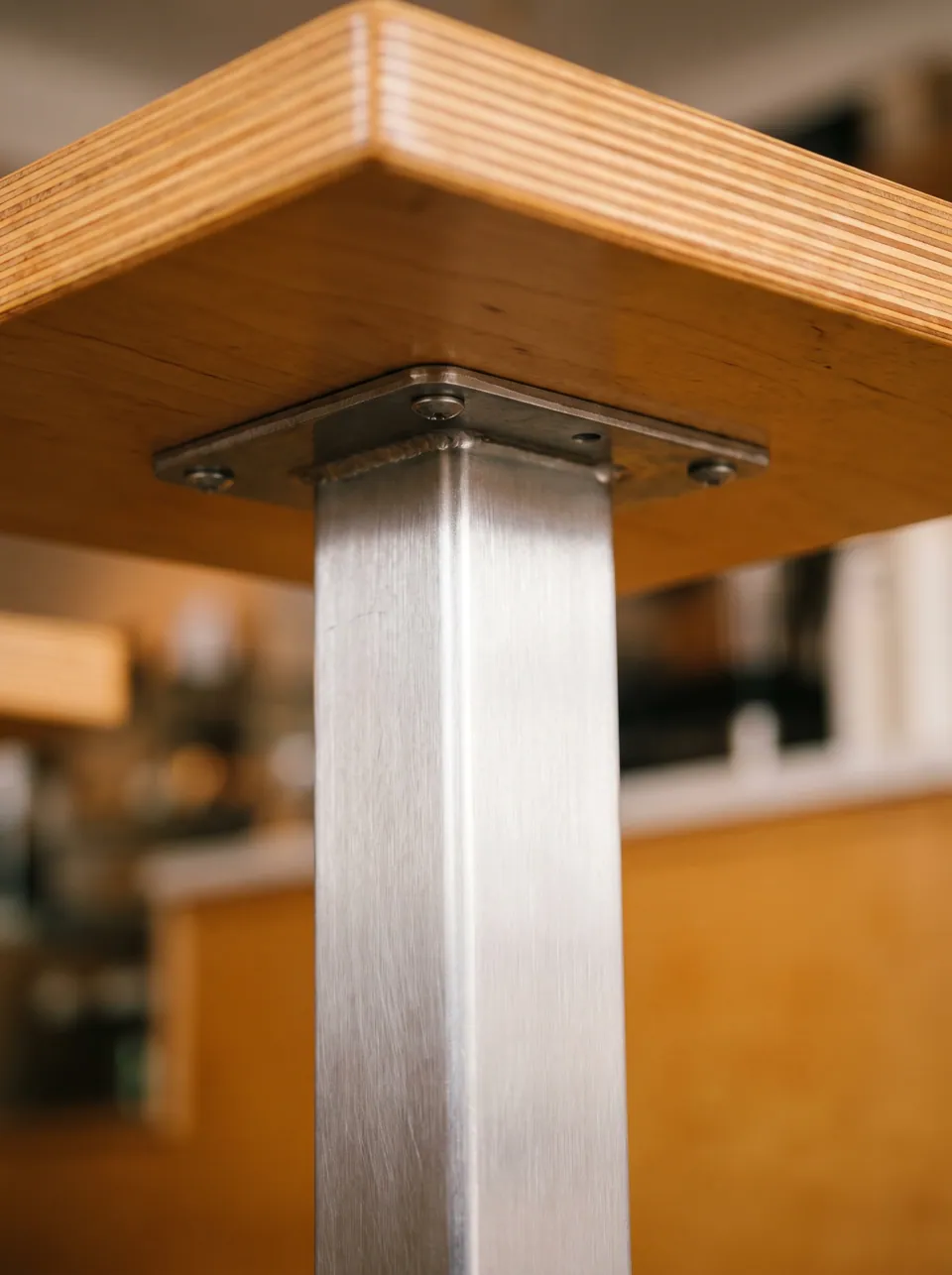
High-pressure laminate (HPL) bonded to a particleboard, MDF or plywood core is light, inexpensive and available in any print. Its weak points are the edge and the core: once water gets past a damaged edge band into a wood-based core, the core swells and the top is finished. For restaurant use specify:
- Moisture-resistant core.
- Thick PVC/ABS or solid-wood edges, never thin tape edges.
- HPL balancing sheet on the underside to prevent warping.
Our Dark-Top Bistro Tables are offered with HPL surfaces inside a solid-wood band, which protects exactly the edge that fails first.
Solid wood: the only top you can bring back
Wood dents rather than chips, and a dented, worn wood top can be sanded and refinished — the only common surface you can genuinely restore. The finish is the whole story: a soft oil looks lovely and fails quickly under alcohol and sanitiser; a hard commercial lacquer or 2K polyurethane handles daily wipe-down. Seal the underside as well as the top, or the timber can cup. See the Solid Wood Tables collection for bases designed around timber movement.
Which top material suits which restaurant?
| Venue | First choice | Second choice | Avoid |
|---|---|---|---|
| Steakhouse, grill, Korean BBQ | Sintered stone (dark) | Solid wood + trivets | Quartz |
| Brasserie, bistro | Sintered stone (marble-look) | Natural marble (honed) | Thin-edged laminate |
| Café, bakery | Laminate in wood band | Quartz, solid wood | Polished marble |
| Wine bar | Sintered stone (dark) | Solid wood | Polished marble |
| Hotel restaurant | Sintered stone | Natural marble | — |
| High-volume casual | HPL with solid edge | Sintered stone | Oiled wood |
How to specify a table top: a checklist
- List the worst things that will land on the top — hot iron, acid, red wine, turmeric.
- Describe the cleaning routine — products, frequency, abrasive pads or not.
- Choose the surface from the comparison table above.
- Specify the edge — band, mitred thick edge or bevel — and the corner radius.
- State the thickness and get the weight — it determines the base size and handling.
- Specify the fixing — threaded inserts or a steel sub-frame, never wood screws straight into a stone backer.
- Approve a physical sample of the surface and edge before production.
- Write a care sheet for staff before opening.
Common mistakes
Choosing by the showroom sample, not by the menu. A polished Calacatta sample looks perfect in daylight; the same top under a lemon-dressed salad looks different after week one.
Specifying quartz for hot food service. It's an excellent surface — until the first sizzling platter.
Thin, sharp stone edges. Chips at the edge are the most common complaint with stone tops, and almost always a detailing problem.
Oiled wood in a high-volume room. It needs re-oiling on a schedule that busy kitchens rarely keep.
Ignoring weight. A 30 × 48 in top in 30 mm marble weighs over 100 lb (45 kg); staff will struggle to move it and the base must be sized for it.
FAQ
Is sintered stone heat resistant?
Yes. Sintered stone tolerates hot plates and serving dishes far better than quartz, laminate or lacquered wood. Avoid sudden extreme temperature shocks, and use trivets under items straight from a very hot oven as good practice.
Does sintered stone chip?
It can at the edge, if hit hard. That's why we protect stone tops with a solid-wood band or a mitred thick edge, and ease every edge rather than leaving it sharp.
What is the most durable restaurant table top?
For combined resistance to heat, stains, acids and scratches, sintered stone. For repairability over many years, solid wood with a commercial finish.
Can marble table tops be used in restaurants?
Yes, with realistic expectations. Marble etches under acids and needs regular sealing. Honed finishes hide wear better than polished ones.
What thickness should a restaurant table top be?
Typically 1–1¼ in (25–30 mm) for laminate and wood-based tops, 1½ in (38 mm) for solid wood, and 12–20 mm for sintered stone, often with a thicker built-up or mitred edge for appearance and strength.
Send your floor plan, cover count or table schedule and we'll reply with suggested sizes, top and base pairings, and a quote. Drawings first, always.
Request a quote